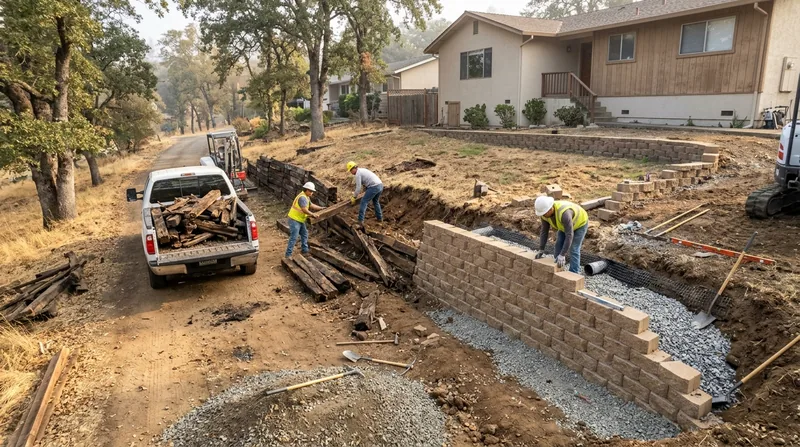




Railroad Tie Wall Replacement in Sacramento: When Those Old Creosote Ties Have to Go
Sacramento sits on the flat valley floor where the American and Sacramento rivers meet, ringed by levees, and the walls that hold up its raised lots tell you a lot about when a neighborhood was built. In Carmichael and Fair Oaks, the 1970s and 80s railroad tie walls are still standing, but many are rotting out from the inside, bowing under dense clay and hardpan that holds water after winter storms. If you need Railroad Tie Wall Replacement in Sacramento, we pull the old creosote-treated ties, haul them away, and rebuild the wall in segmental block, concrete, or natural stone with proper gravel backfill and drainage. We work the valley floor from Land Park and East Sacramento to Natomas and the Pocket, and east into the decomposed granite foothills of Folsom, Granite Bay, and El Dorado Hills. For the full range of what we build, see our retaining wall replacement page.
Why Railroad Tie Walls Are Failing Across Sacramento's Older Neighborhoods
Railroad ties were cheap and easy in their day, but they were never built to last fifty years in Sacramento soil. Creosote-treated timber rots from the inside out, especially when the back of the wall sits against dense clay that holds winter moisture. The failure mode that dominates here is not coastal salt or freeze-thaw, it is saturated clay pushing on a wall that has no drainage and ties that have lost their structural section.
- The ties rot at the soil line and behind the face, so the wall looks fine until it leans.
- Dense clay and hardpan trap water after storms, and the hydrostatic pressure bows the wall outward.
- Creosote leaches into planting beds and is a disposal concern when the old ties come out.
- Missing gravel backfill and drain pipe mean the replacement wall will fail the same way.
- Raised lots in Land Park, Curtis Park, and East Sacramento often have low garden walls that hide the problem until a section collapses.
When a tie wall starts to lean, the fix is rarely a patch, and that is why we scope the whole wall before we quote it.
Key info: A 1978 tie wall in Fair Oaks that leans after a wet January is a drainage failure, not a tie problem. We rebuild those walls with washed gravel backfill, filter fabric, and a perforated drain pipe that daylights at the low end of the wall.
For permit thresholds and inspection requirements, verify with the Sacramento Community Development building division, since rules vary by jurisdiction and wall height.
How We Replace a Railroad Tie Wall in Sacramento, Step by Step
Every replacement starts with a site walk and a look at what is behind the wall. We check the soil, the slope above, any surcharge from a driveway or structure, and where the water needs to go. Then we sequence the work so the yard stays usable and the old ties come out without undermining a fence or a neighbor's grade.
- We mark utilities and confirm the wall line, height, and setback before any digging starts.
- We remove the old ties and any rotted backing, then haul the creosote-treated material to an approved disposal site.
- We excavate to the footing depth and compact a base of crushed rock sized for the wall type.
- We install the new wall in segmental block, poured concrete, or natural stone, with filter fabric and gravel backfill behind the face.
- We set a perforated drain pipe at the base and daylight it, then backfill and compact in lifts.
- We cap the wall, clean the site, and walk the finished work with you.
If the old wall sits on a slope that has already started to move, we address the grade before we rebuild, because a new wall on a failing slope is money thrown away. See our slope stabilization and erosion control work for those cases.
Key info: On a Carmichael lot with a 3-foot tie wall holding a raised garden, we replaced the ties with segmental block, added a drain pipe that daylights at the driveway, and the homeowner gained usable planting depth behind the wall.
Replacement Approaches We Use in Sacramento
The right replacement depends on height, access, and what the wall has to hold. We match the material to the site rather than selling one system for every yard.
| Approach | Description | Best for |
|---|---|---|
| Segmental block replacement | Engineered block with gravel backfill and drain pipe, built in lifts. | Garden and terrace walls in Carmichael, Fair Oaks, and Citrus Heights. |
| Poured concrete replacement | Formed and reinforced wall with a footing sized to the load. | Tall walls and walls carrying a surcharge near a driveway or structure. |
| Natural stone replacement | Granite boulder or stacked stone wall fitted to the grade. | Foothill lots in Folsom, Granite Bay, and El Dorado Hills. |
| Timber-to-timber swap | New pressure-treated timber with proper drainage behind it. | Low garden walls where the budget is tight and height is under 3 feet. |
| Partial rebuild with repair | Replace failed sections and stabilize the rest of the wall. | Walls where only one run has rotted and the rest is sound. |
We tell you which approach fits your wall and why, and we do not upsell a concrete wall where a block wall does the job.
Railroad Tie Wall Replacement Cost in Sacramento: What to Expect
Most railroad tie replacements in Sacramento start at From $35/sq ft, and that figure moves with height, access, and what is behind the wall. A low garden wall on a flat lot in the Pocket is a different job from a tall wall on a cut-and-fill lot in El Dorado Hills where the equipment cannot get close. Removal and disposal of creosote-treated ties add cost, and so does any repair to the grade above the wall.
- Wall height and total square footage drive the base number.
- Access matters: a backyard wall behind a fence and a shed takes longer than a street-facing wall.
- Soil and drainage conditions add work when clay and hardpan need over-excavation.
- Material choice moves the price, with segmental block and concrete at different points.
- Permits and engineered drawings apply to taller walls and walls carrying a surcharge.
Get two or three written estimates and compare scope, not just the bottom line, because a cheap quote that skips drainage will cost you again in five years. Our full pricing overview breaks down the ranges in more detail.
Hiring a Retaining Wall Contractor Near Me in Sacramento: What to Check
Replacing a tie wall is a structural job, so treat the hiring process like you would for a roof or a foundation. Get at least two or three estimates in writing, and ask each contractor how they handle drainage, because that is where most walls fail.
- Check references from jobs in your part of Sacramento, not just photos of finished walls.
- Ask who pulls the permit and whether engineered drawings are needed for your wall height.
- Confirm how old creosote ties will be hauled and disposed of.
- Get the drainage scope in writing: gravel, filter fabric, and drain pipe location.
- Read the contract for what happens if the excavation reveals a problem behind the wall.
When you are ready to talk through your wall, contact us for a free estimate and we will walk the site with you.
Railroad Tie Wall Replacement in Sacramento: Pricing Guide
| Service | Price | Details |
|---|---|---|
| Low garden wall replacement | Starting at $35/sq ft | Includes tie removal, haul-away, gravel backfill, and drain pipe on walls under 3 feet. |
| Segmental block rebuild | Starting at $45/sq ft | Engineered block, compacted base, filter fabric, and drainage for typical residential walls. |
| Tall or surcharge wall | On estimate | Walls over 4 feet or carrying a driveway load need an on-site look and possibly engineered drawings. |
| Creosote tie disposal | Included | Old ties are hauled to an approved disposal site, no separate dump fee on standard jobs. |
| Travel | Included | In Sacramento and surrounding areas, no separate call-out or mileage fee. |
| Estimate | Free | Response within 24h at (916) 891-1319, no obligation to book. |
Indicative pricing, the exact cost depends on square footage, finish, and site access. Free personalized estimate within 24h at (916) 891-1319.


